One of the wonders of living in the 21st century is the seemingly limitless options we have on anything. From shopping to elected officials and from cat pictures to socializing. When presented with such an – at times overwhelming – number of choices one has to be able to keep up with the pace, not so much concerning the quantity but the quality of said choices.
The thing is though, that more often than not, we are offered to just choose what we like best. Think about it. We bookmark our preferred sites, star our favorite tweets, like the best facebook posts and comments, listen only to the music we like, vote for the politicians that we think can best represent us. We only aim towards what we want, what we think is best, while completely ignoring everything else. No ‘but’s no bargaining. Either take it, or leave it.
We are operating under a general lack of dislike means and limited negative feedback options.
I am not saying that positive feedback is a bad metric, but one that is overused compared to others that complement it. Positive feedback alone cannot present the full picture and also usually doesn’t contribute in the creation of new developments, but rather prolongs existing states. Still not convinced? Well, time for the obligatory post example.
Let’s say a friend of yours uploads his or her music video on youtube. After a couple of years the video has amassed an impressive 330000 likes! Likes, as in positive feedback. Such numbers can only relate to a complete success right? 
Miss Black is a perfect example. Without knowing the number of dislikes one would immediately presume that such a number of likes could only be hiding at the very least a one time successful artist. The song’s success is arguable mainly thanks to the gigantic view count. So how does one interpret the facts?
- around 3/4 people who listened to the song expressed their dislike to it
- over 330000 likes
- over 60000000 views
Does the world want more of miss Black? View count is huge and a market of people that is counted in six-digits cannot be ignored, the answer is an obvious ‘yes’. So taking only the positive feedback into consideration, at first we ignored around 3/4 of people’s opinions and then we concluded to repeat doing the same thing over and over. Or in other words doing exactly what my two points concerning positive feedback described.
So what else can negative feedback offer other than a better estimate on the total number of users? Well it depends on the way it is implemented each time. Disliking the above video for example has immediate user benefits. By flagging it as a piece one would rather avoid, the youtube platform is trained to refrain from providing content of the same type to the user. The examples are endless and they range from making food tastier to cleansing toxic players from game communities.
But if the benefits are so great, why isn’t this form of feedback much more adopted? This is the thing that probably bugs me most concerning the subject. Our very bodies are programmed to react almost exclusively to negative inputs. Why can’t we think more in the same way?
Well for one negative feedback often leads to new things and new things can often be very scary. Nevertheless new things being introduced probably means that we have not yet achieved the desired level of pluralism.
- Why vote for a different political party that promises the exact same things all the others other did and never successfully completed?
- Why try eating raw fish when there’s the option of tasting a perfectly cooked and juice steak?
It also presents a level of undesirable negativity if not implemented properly.
- Why would the admins of TGTSNBN waste time moderating the IG group instead of negative posts in the OOG one that could probably make paying players stop playing? Why address a problem when one can just make it seem as if it doesn’t exist?
- Who would ever keep regularly using a hypothetical facebook dislike button that was just as visible as the like one?
And finally negative feedback is by definition limiting whereas positive feedback is not, even leading to unknown states. I don’t want to spend too much time presenting this argument so I’ll be using pictures of the two types of feedback implemented on simple automatic control systems.
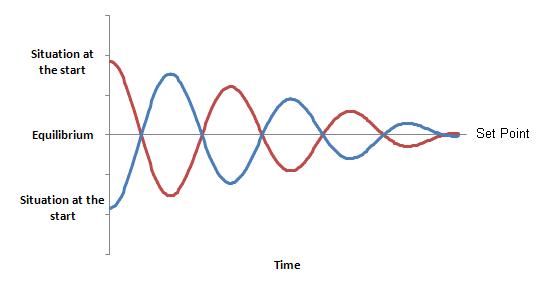
The first image presents the use of negative feedback. Each curve starts off at a random point and through experimentation, trials and errors finally reaches a desired point, or small area close to it, after having discarded every other point/area as not ideal.
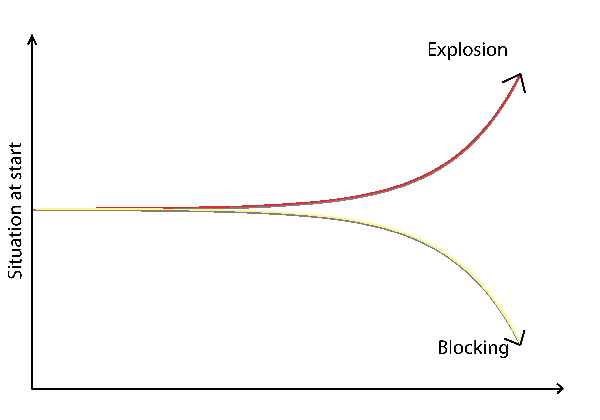
The second image shows the use of positive feedback. They too start of at a random point and react to an addition or subtraction in the same way, by adding and subtracting respectively. Unlike negative feedback there is no equilibrium, no goal to be aimed at. Just a repetition that leads to unknown states that eventually become unstable or unable to function anymore. But before reaching a critical point everything seems to be running smoothly, and that’s exactly what everyone that adopts a positive-feedback-only way of thinking aims to do: extend the time before that point is reached while reaping benefits in the meantime.
By having a like button facebook accomplished getting probably the biggest database of disgustingly detailed user profiles. When League of Legends introduced the honor system the input was so great and because almost everyone used the system, most players ended up with the same honor ribbon. By adopting the arguably most positive slogan of all time McDonald’s made sure that it would be sought after even by people traveling to countries other their own instead of available local cuisine. So lets get to the real point I am trying to make.
Negative feedback, dislike buttons, downvotes. They are the choices that more often than not are taken away from us and thus we sometimes forget they even exist. Our societies and media are – intentionally or not – making us adopt a way of thinking and decision making that almost exclusively involves positive feedback.
What I really want for people, for every one of you reading this, is to regain that way of thinking. To set goals and equilibriums and cut off anything that derails you away from them, even when everything points to such options being unavailable. This along with my sincerest hopes for you to have a healthy, happy and prosperous year are my wishes for 2014.
May it be an excellent year!

dislike gia tin monopleuri estiasi tou thematos.. mhdenikh anafora stin anthrwpini psixologia kai tis arnitikes epiptwseis pou tha xei i eisagwgi enos dislike button.
1on An mporeis tha se parakalousa na sxoliazeis sta agglika gia na yparxei dynatothta na parakolouthoun kai na symmetexoun oloi sth syzhthsh.
2on an nomizeis oti ta apospasmata:
“negative feedback often leads to new things and new things can often be very scary”
“presents a level of undesirable negativity if not implemented properly”
“Who would ever keep regularly using a hypothetical facebook dislike button that was just as visible as the like one?”
den prosferoun trofh gia skepsh me thn anafora se vasikh anthrwpinh psyxologia, tote mallon de diavases oloklhro to arthro.
An theleis toso poly mia plhrh analysh (oxi aplh anafora) mporeis apla na to zhthseis kai na to lavw yp’ opsh gia mellontika arthra. Alla prin apo ayto se parakalw na diavazeis prosektikotera prin isxyristeis pws leipei kati apo to arthro enw yparxei kai apla esy to prosperases h agnohses. 🙂
episis na valeis ena voting tis prokopis.. thes na pareis kai ptixio ilektrologou.. tsimpa 165 negative votes! 😛
To arnhtiko feedback sou me odhghse se ena kainourio systhma pshfishs. Oute sthmeno na htan gia na epalhtheysei ta parapanw. 😎
Good job apo, nice…
Although a little pessimistic, legit and valid arguments! Thanks, keep it up!
And don’t listen to stupid ECEs that believe in internet UPSsss