I was not planning on adding this first part to the intro, but since people are – surprisingly – still asking and one of the reasons I like having my thoughts easily accessible is being able to effortlessly have people refer to them without having to repeat myself over and over, I guess I can squeeze in a couple of paragraphs. They actually should be quite coherent with the rest. The things I am still getting asked are something along the lines of:
-What is/was the army/experience like?
-What did you get out of it?
-Did you make the right choice by going?
So answering in reverse order:
-Yes, there were quite a few pros and cons, after weighting them and considering all circumstances I made a choice. And since it was my choice it was and will be the best. I could elaborate more, but decision-making and reflecting on past actions are solid materials for a proper future post.
-While answering “nothing” always tempts me, it would truly be an understatement. It is in fact possible to get something good out of any situation. And while the Greek army did not offer me challenging experiences in terms of schedules, or having to cooperate, or follow orders, I still managed to get some things out of it. A couple of new friends, some technical work experience, a confirmation on my theory about the world. Which brings me to my next answer.
-Most of the people asking me this are already very familiar with most of the rest of the Greek public system and services. So my response automatically defaults to “How do you expect a part of the thing you are so familiar with to be any different?”. The interesting part is, that I am not trying to imply anything with my tone or wording, just what I consider to be pure logic, yet everyone assumes that I say it in a negative way. Now why would that be? Hold that thought while I recall another recent experience. I will try my hardest to keep the story to the shortest possible version while still noting important details (which basically translates to “excuse the narrative quality”).
It was a hot summer day of the past July and yours truly was chosen to be a member of the election committee at my voting center. The options available to each voter assuming he presented himself with a will to vote were:
1. vote yes on question paper provided
2. vote no on question paper provided
3. choose the blank paper (also provided)
4. put anything else on the envelope, or not follow the instructions, or damage the provided papers and some other stuff that would render their vote invalid. So just choose either paper, if question paper is chosen, choose by drawing a cross on the respective designated areas. Simple right?
So people come and go, and the committee president – a lawyer assigned by the state – insisted of separately informing each voter, regardless of age or the length of the queue of people waiting, of the proper voting procedure. So during a short break, she tells us how people always manage to invalidate their votes by not following the simplest of instructions. So far so good, it is to be expected somewhat (elders, idiots, hasty first-timers, you name it). But right after that she informs us that a little bit before we would be starting counting the votes, an order would be issued – as usual – that would specifically state that votes marked with X instead of crosses should be considered valid. The rest of the conversation went something along the following lines:
-(Me) Why would they need to tell us that?
-(Her)Why wouldn’t they?
-Do you know what a cross is? Do you know how a cross is defined?
-… (silence by all other members)
-A cross is a geometric shape consisting of 2 crossing line segments perpendicular to each other.
-Okay…
-So why isn’t an X a cross that has been rotated by 45 degrees?
-I don’t think most people view it that way.
-But it is that way. And considering how a cross is a clearly defined shape I don’t see the need of the order issuing about Xs.
The above conversation is greatly shortened but I think it gets my point across (bad pun intended). For those that are already screaming at their screens that the definition of a cross contains a “with one or both of the segments being divided in half” part I have two responses. The first one is that you should really get some better sources. The second and most important one is that I did my homework before presenting myself as a committee member. Even though I would have much rather preferred to stay home and pull-off an Umaru (basically hugging an AC-unit and eating ice-cream), I searched for the laws that described the operation of the committee, I learned my duties and rights as a member of it and I even searched for the segments that described how counting is done, which votes are considered valid and which are not, and so on and so on. And guess what, there are numerous law cases and additions that specifically state the acceptable margins and extreme cases that a cross drawn on a voting paper can satisfy and still be considered valid. So even if we were to go along with the stupid strict definition, any cross that did not equally divide parts would still be valid, any cross that was shakily drawn would be valid (we did have a voter with progressed Parkinson’s disease) and a rotated-by-45-degrees-cross was already covered without the need of an added order.
So I decided to kill my boredom constructively invest my time half-trolling and half-trying to make the rest of the committee members think of what consists a cross, and how for example a tick should be considered a valid cross for election purposes. I even kept drawing them cross shapes on papers. The following work of art does not contain all of the wonderful shapes I drew that day, but still displays my amazing paint skills.
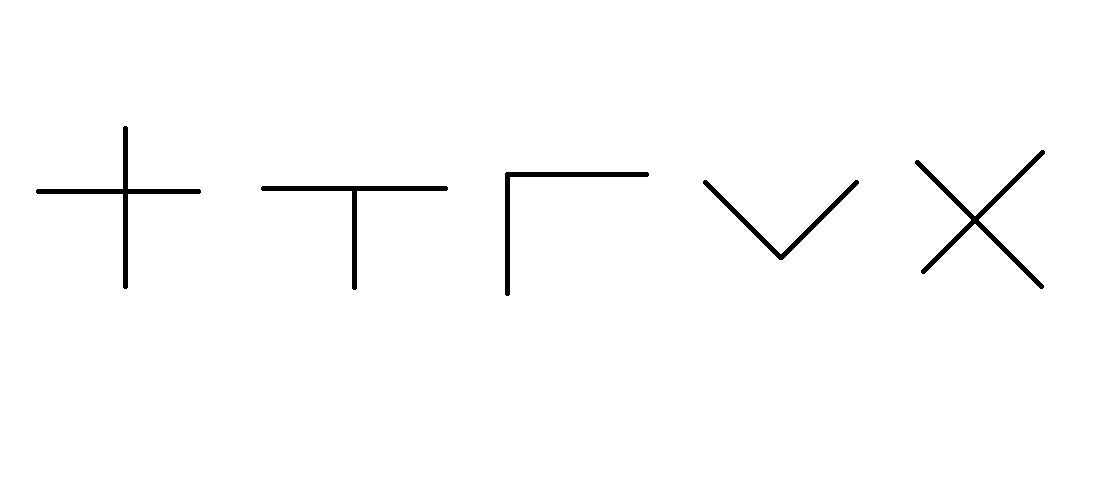
I had a lot of fun, the shapes, the characters (T ^ Λ Γ v x L), it was so much material for it to go to waste. Eventually I had to settle and respect that only crosses and Xs would count as valid votes as the only opposing minority of the committee. Thankfully and probably thanks to the president’s informative approach towards every voter, we did not find any “accidental” invalid votes. Yet there I was, around 9 p.m. double checking votes while wondering how a person was ruined enough to not accept a geometric shape, even more so when that person is a lawyer, the very profession of definitions and laws and rules. And I might have just dismissed the whole day as another classic case of incompetence, after all I am 100% sure that even engineers graduating the same year that I did cannot properly define a cross (yes, I asked them personally), but then the second incident of the day happened.
So it’s around 9 p.m. we are double-checking votes and filling the required reports with the results when the committee president of the next center enters ours to ask us how a part of the forms should be filled. Our president is quite busy finishing so the rest of us offer to answer since we have seen how most of the forms are filled. So here we go, discussing with a lawyer about the simplest of stuff part two:
-(Her) Can you help me with something?
-(Me) Sure.
-Here on the form it asks for the sum of “yes” and “no” votes.
-That’s correct.
-But right below it asks for the sum of valid votes.
-That’s also correct.
-But why? Aren’t those the same thing?
-No…
-What? Are you kidding me?
-No I am not, “yes+no” is not necessarily the same as valid votes.
-But valid votes are only “yes” and “no” ones.
-No, valid votes are “yes” “no” and “blank”.
-And how do you know that “blank” votes are not invalid?
-Because we offered them as a voting option the whole day along with the question paper?
-So?
-Do you even know what a valid vote is?
-“Yes” and “No”.
-VALID are the votes which are NOT INVALID, that includes “blanks”.
-Sir what are you talking about? Let me talk to your president. Are you even an election representative of the state? Are you a lawyer?
To which I MAY (or may have not, guess which) have replied with “No, I’m just NOT an idiot”.
A lawyer, hired and paid by the state, to be in charge of the holiest of democratic procedures, does not know which votes are valid and which are not. Those who have been told the above also heard a third story. And it is really the combination of all three that really shapes this really big introduction (but hey, I got pictures in order for you to not get bored). The day after the referendum I woke up after having a memory flashback while dreaming. It was then that I realized the extent of this saddening phenomenon. So to make this story even shorter take a look at the following image. Again excuse admire my painting skills, since I have not managed to get a hold of the 20+ year-old-book containing the original image and it is not available for download.
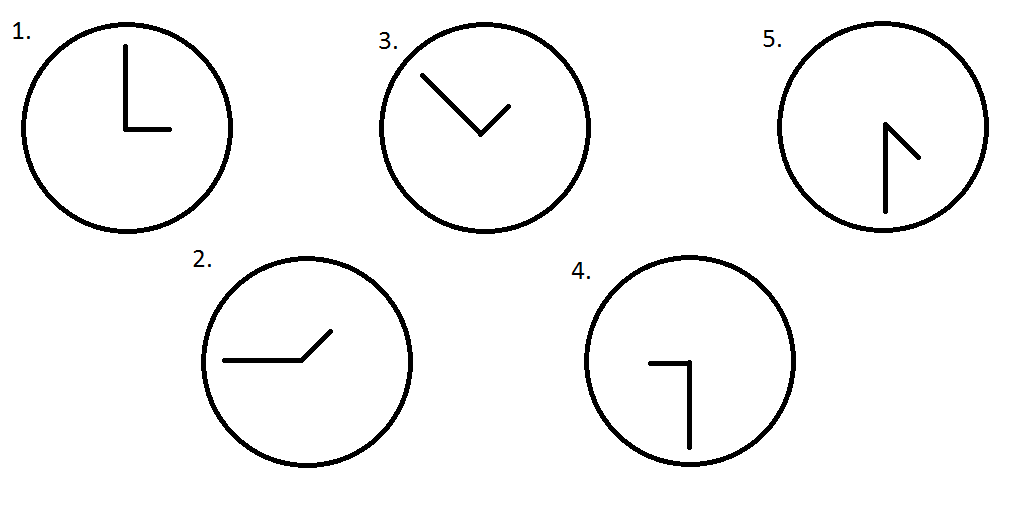
The year should have been 1997 when my third grade teacher tells class that only “clocks” 1 and 4 have hands that form right angles as an answer to a math problem. I disagree and proceed to spend the whole of my break trying to convince her that 3 too has hands that form a right angle. Teacher eventually caves in by the end of the break, but when class resumes she refuses to admit her mistake, probably thinking that the shame of admitting such a mistake to the whole class would be bigger than her ego, certainly most important than 27 other 9-year-olds being taught properly and just moves to the next exercise. It was the first time in my life that I encountered the truly limitless force that is human stupidity. Fortunately my first argument with a teacher did not stop me from becoming a seeker of the truth, even if that made me look like the odd/crazy one.
The thing that these stories have in common is that they present all possible combinations of unwilling and/or unable people, failing at executing a task that has been entrusted to them, because of their characteristics.
The first lawyer was willing to do her job. She was prepared and organized, she tried her best, she went out of her way to repeat the voting procedure around 350 times in a single day to make sure everything was done properly, she was methodical, she was even willing to listen to my troll-y claims. But in the end she was unable to accept the truth, maybe she wasn’t taught properly, maybe she did not pay attention in geometry, maybe that was a revelation of gigantic proportions for her to swallow.
The second lawyer was the worst, both unwilling and incompetent. She lacked even the most basic knowledge of her job and she fiercely refused reality, outside help and logic. People like her are everything that is wrong in this world, but we’ll get to that later.
Finally my third grade teacher was – eventually – able to understand what she should have known from the beginning, yet she was unwilling to do her job properly, despite being – eventually – able to do so.
There are two tricky parts regarding this whole issue. The first one is the answer to “Can we fix this, and if then how?”. The second part, which will eventually lead to the answer of the previous question, is our (dis)ability of objectively identifying those characteristics. Take a person, any person and ask him to point out unwilling or unable people. That would be considered easy by most, yet too time-consuming if they were to complete that list. Now ask that same person to identify those same characteristics on himself. Chances are the response will be either negative, or accompanied by “reasons” that make that very person’s case “special”.
Remember that thought I told you to hold at the very beginning? It’s not the army as a whole that is the problem. It is not any other sector for that matter. It is each individual that finds it easier and more comforting to point the finger at others (bonus point for larger groups) than himself. The sad thing is that even if all that feedback was constructive and well-intended, it would still be mostly useless, since the only one who can overcome unwillingness and incompetence is the individual expressing them.
“But how can an individual incapable of performing, properly execute what he clearly can’t?”
The proper question would then be “Why can’t he?” Is it because that individual was never properly taught what a right angle was in 3rd grade? Is it something he or she just neglected and never learned when he or she should have? I for one, am sure that the average 6-year-old could have a better grasp on invalid votes than the second lawyer’s if introduced to the concept. So can this part still be fixed by learning just in time? Contrary to what it may appear at first, most cases of “incompetence” can be overcome as long as the individual is willing to do so. This does not mean that everyone can acquire every single skill because he or she wills and tries to, but they would at the very least learn if they are really suited for that skill or not when trying instead of pretending. And it is not a solo trip, only the decision to start it is. On the way many tutorials, friends, bosses, volunteers, examples will show up. All it takes is one small first step (which basically applies to almost anything).
“So it all boils down to willingness?”
Well… kinda, yes. That is what has been leading those who DO all along. The will, the drive, the reason, the passion, the excitement, the dreams. It can be a different thing for anyone. I have had good teachers motivated by the thought that they were teaching the future generations and I have also had great professors who were just loyal to their specialization that unintentionally turned into inspiration for others. There is no recipe, no formula. It unquestionably also is a search that is often doomed to fail in our modern times. Too much pressure and too many distractions usually hinder any progress in the right direction. Living in our time often involves too much compromising and compromise leads to never-ending stray paths. It is when reality kicks in that the simplicity of every utopian thought becomes even less than wishful thinking. And that reality is nothing else but the result of the collective unwillingness of our modern society, a society that constantly denies people the very things they want.
“In the end, people cannot change.”
I have been using that argument for quite some time. I almost always add “If they could, why haven’t they done so already?” at the end. I really believe they can’t, and by “they” I mean “most”. Those few exceptions that can or might, could usually really use a small push towards taking that first step. And while the rest of the world can stay hopelessly stagnant for all eternity, it will always be those individuals moving forward that will – if ever – change the negligible momentum for everyone’s sake. That is not the point though! Changing the whole to something better is only a happy after-effect.
As selfish as it appears to be, it is probably the best goal to spend one’s ego on. After all we have tried all other uses of it while growing up. We do not practice trusting or relying on others enough, nor do we try to understand them. Instead we opt to see them as different than us in our efforts to reassure our existence and choices. These are the very habits that trick us into thinking that “someone else, but not us” is the enemy – whether those be our politicians, our bosses and coworkers, our neighbors, another country on this planet that we have not even visited yet. Yes it sounds cheesy and corny, but we are indeed our worst enemies and not realizing we can be more than what we already are, is an impediment that has to be overcome before any progress, betterment, or evolution can take place. The real war is trying to surpass ourselves under the worst of circumstances, and as with any war, knowing the enemy is the major requirement for securing a win.

Niiiiiiice! Don’t become wise too early man… 😛
Not trying to be. Just developing and expressing my thoughts. 😀
The constant battle for improvement can only be lost by those who claim to have won it.
“The real war is trying to surpass ourselves under the worst of circumstances”
To which I shall add,that it is a never-ending one.Winning battle after battle contributes to becoming better and better,until you fall under the illusion that you can no longer be improved.Then and only then,you have truly lost the war.